Free your sales team up from finding, researching, qualifying and ranking prospects.
A good rep can lose the better part of half an hour researching a single company before they even know whether it is worth a conversation, and a CRM that has been running for a few years is usually full of records nobody has opened in months, contacts who moved on long ago, and accounts that were never really a fit, so the people you pay to close end up spending their best hours sorting the list instead of working it.
AlignIQx takes that whole layer of finding, researching, qualifying, ranking and housekeeping and turns it into a system that runs quietly in the background, scoring every account against the ideal customer profile your own team defined, so that your reps open the CRM to a ranked, current and fully researched view and spend their time only on the prospects that are genuinely worth it.
The system identifies the best accounts, the right buyers and the right moment to reach them, and the advantage that hands you over your competition is simple: speed.
Running inside industrial and B2B sales teams for three years, on more than two million records.
A cleaner pipeline, faster handoffs and more closed business.
Everything on this page exists to produce three changes you can see from the outside, and each one follows directly from putting a single agreed picture of your ideal customer at the centre of the CRM.
Your pipeline fills with target prospects
Because the focus of the whole team shifts from broad activity to a ranked list of qualified accounts, the pipeline stops being fed by whoever happened to arrive and starts being fed by the companies you actually want to win.
Business development reaches deals quicker
Because the research that used to swallow the first half hour of every approach is already done, your people arrive at each conversation prepared and spend their hours with the client rather than with the browser.
Client teams close more
Because marketing, business development and client relations are all working from the same ideal-client picture and the same personas, effort lands on the same target opportunities instead of being scattered across three different ideas of a good customer.
The real problem is that you do not have enough quality target opportunities.
It is not your team and it is not your CRM, because the pattern repeats in almost every database we open, and it looks like this.
What you think you have
A CRM that has been filling up for years looks like sixty quality opportunities that match your ideal customer profile, and everyone plans as though they are real.
What you actually have
Once every account is researched and scored honestly against the profile, only a small number genuinely fit, and it is usually a shock how small that number is.
What you can build it into
With the definition agreed and the system keeping every record researched, scored and current, the true count climbs month after month, and the CRM becomes a focused lead engine rather than a large but uncertain database.
Validated and refined over more than two million processed records.
AlignIQx has been running inside real sales teams for three years, across industrial and B2B companies from the low tens of millions up to nearly two hundred million dollars in annual revenue, and in that time the system has researched, scored and kept current more than two million of their records, which is the reason everything described on this page is something already working in practice rather than something we are hoping will work.
researched, scored and kept current
of research per company handed back to your reps as selling time
Bad emails, wrong-fit accounts and people who have moved on most likely plague your CRM.
A constant feed of new prospects, found, researched, qualified and ranked before they reach a rep
A practical path from vague targets to a working lead machine.

Diagnose
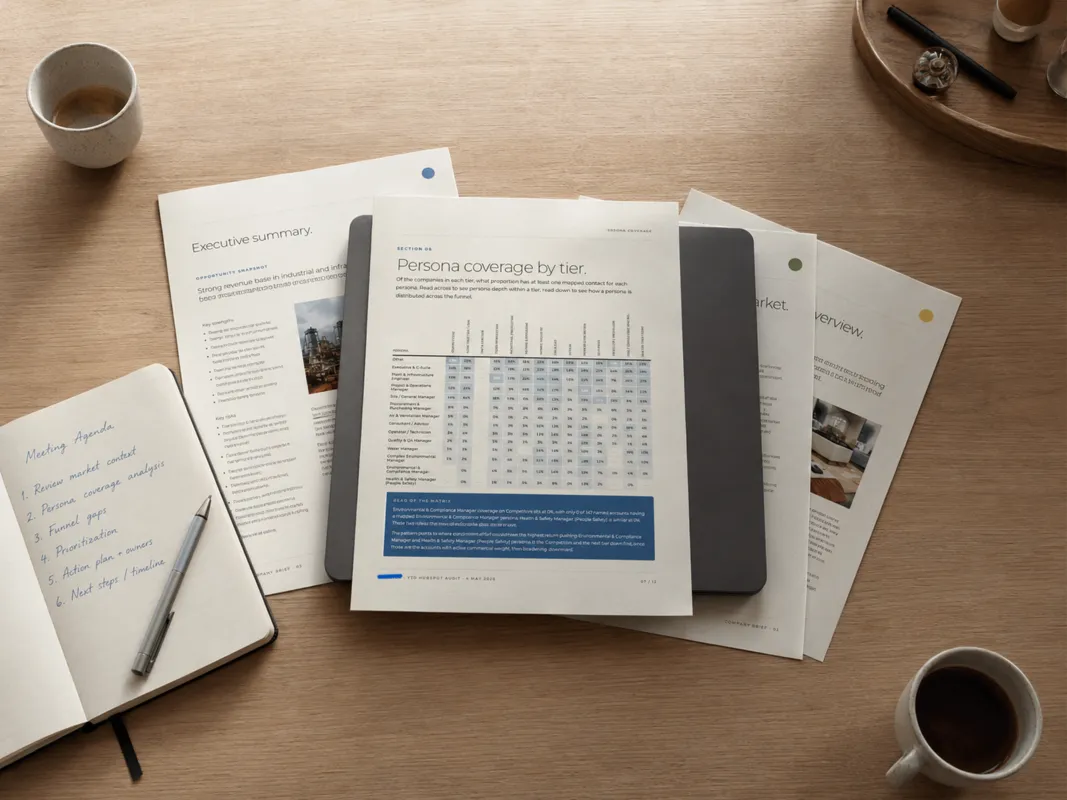
Diagnose is where the truth gets shown before anyone is asked to commit, because a sample of your own CRM run through the system reveals the real picture of completeness, duplicates, stale records, profile fit, market distribution, contact validity and persona coverage, using your data rather than a slide of someone else's.
DeliverableA diagnostic report that shows how much stronger your prospect list can become.

Define
Define is where the rules get built, because a system that scores and prioritises accounts is worthless until there is a clear and agreed definition of what a good customer actually looks like, how one account is ranked against another, and who the real decision makers are, all of which is drawn out of the people on your team who sit in front of customers every day.
DeliverableDocumented ideal customer profiles, weighted scoring and a persona library your team has signed off.

Align
Align is where that definition is applied to everything already in your CRM, so that every account is researched, scored and ranked, every contact is matched to the right buyer persona, the gaps get filled and the records that have gone stale get flagged, and from then on anything new that arrives is held to the same standard before it is ever allowed to clutter the database.
DeliverableA true count of qualified accounts and contacts, with every record researched, scored and ranked.

Grow
Grow is where the pipeline is widened beyond the accounts you already hold, with new targets found, validated and researched, the events that create a reason to reach out caught as they happen, and genuinely personal outreach landing with the right people, so that the top of the funnel keeps filling with accounts that arrive already qualified and with a reason for the conversation attached.
DeliverableA pipeline that keeps filling with validated targets and timely reasons to reach out.
Each step makes the next one stronger, because the automation can only scale what the definition makes precise, which is why the foundation is laid before anything is switched on.
The whole system, walked through end to end.
If you would rather be taken through it than read it, this is the same story narrated from start to finish, covering the problem, the four steps and what each one delivers.
Without the ICP, your CRM is just a contact list.
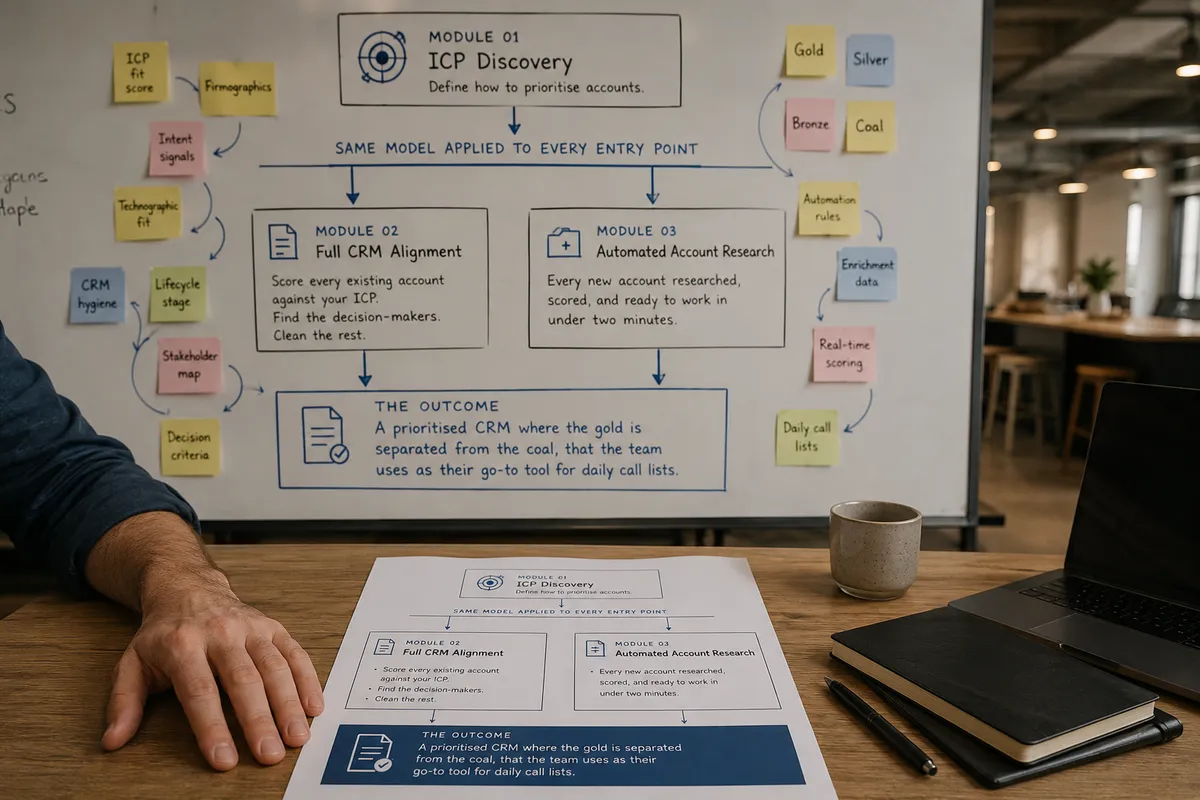
Your CRM should be the thing that sets your team's priorities, telling them which accounts deserve attention first, which records have gaps worth filling, and which ones are quietly absorbing effort that will never convert, and it can only do that once the ideal customer profile is wired into it as a live scoring framework rather than sitting in a slide deck that nobody opens.
Without that scoring in place there is no reference point for any of it, so outreach runs against a flat list instead of a real definition, and the judgement about where to spend time falls back onto each rep's instinct, which is exactly the manual and inconsistent guesswork the whole system is meant to take away.
Once the profile is activated inside the CRM, the prioritisation is done for the team rather than by them, every account carries a score and a tier from the day it lands, and the database stops being a place where people log what they have already done and becomes something that tells them what to do next.
Not every account deserves the same attention.
Once every account has been scored and tiered against the profile your own team defined, the prioritisation becomes obvious, so that your strongest reps are pointed at the gold accounts where their time genuinely converts, while the accounts that score as coal are quietly held back from outreach rather than being allowed to soak up effort that was never going to pay off.
How you choose to work each tier is entirely up to you, because all the system does is sort every account into the right tier and tag it, which leaves the question of how hard to chase each one firmly in your hands.
Three modules that work as one system.
The work is delivered as three modules that share a single definition of a good customer: the ICP module, which establishes the rules; the Align module, which brings your existing database up to that standard and keeps it there; and the Grow module, which widens the pipeline beyond the accounts you already hold. They are designed to fit together as one system, and you do not have to take all of them at once.
The first engagement is deliberately small, so you see the truth about your database before anything wider is discussed.
See what your CRM really holds before you commit to anything.
We take a sample of your CRM, run it through the same research and scoring that powers everything on this page, and hand you a report that shows what your database really holds: how complete the records are, how many are duplicated or stale, how well the accounts fit the profile you believe you are selling to, how your market is actually distributed, whether the contact details still work, and where the persona coverage has gaps. You see the size of the opportunity in your own numbers, and only then does a conversation about the wider system make sense.
Everything starts here, because nothing that follows has anything to score against until the definition exists.

ICP and persona definition.
The reasons one customer turns out to be gold while another quietly wastes everyone's time live in the people who sit in front of customers every day rather than in any piece of software, which is why the profile is built out of their first-hand knowledge and then checked against what your won and lost deals actually show, instead of being guessed at from the top of the organisation.
Your database brought up to standard, and kept there.
Once the profile and the scoring exist, your whole database is brought up to that standard and then held there, so that the state of your CRM stops being something that slowly decays between the occasional clean-up and becomes something you can simply trust on any given morning.
Your team opens the CRM to a ranked and current view of their accounts, where the score and the tier are already sitting there to tell them where to start and the key decision makers have already been identified, so that the long stretches that used to disappear into researching a company before a single conversation are simply handed back as selling time.
Everything needed to place an account against your profile and give it a score is researched and written back, alongside the standard company detail your team relies on, such as revenue, staff numbers and location, and because the fields are matched to the way your sales process actually works, the rest of what your salespeople need to carry a deal forward sits there too, right where they are already working.
With the rules in place, your existing database is brought into line and then held there as new records arrive.

CRM refresh
A single thorough pass across your entire existing database researches, qualifies, scores and ranks every account, matches every contact to the right persona, fills the gaps and flags the records that have gone stale or whose people have moved on, and leaves you with an honest picture of how many genuinely qualified and marketable contacts you actually have, which is almost always a smaller and more useful number than anyone expected.

Continuous account research
From the refresh onward, every new account that enters your CRM comes back, shortly after it lands, fully qualified and ranked and with its key decision makers identified and attached, so that the database stays accurate and current without anyone on your team having to stop what they are doing and run the research by hand.

New-contact screening
A gate sits in front of your CRM and checks the trade-show lists, the purchased data and the inherited spreadsheets against your profiles before any of it is allowed in, so that the obvious non-fits are stripped out at the door and never get the chance to clutter the database in the first place.
Your pipeline widened with accounts that arrive already qualified.
With your database clean and ranked, the system widens the pipeline beyond the accounts you already hold, surfacing new targets that are researched and scored before they ever reach a rep.

Targeted list building
You describe the kind of companies you want to reach and a validated, ready-to-use list of matching target accounts is researched and returned, flowing straight into the same qualifying and enrichment work, so that the new names arrive already scored rather than as a raw list that somebody then has to sort through.

Inbox intelligence
Quiet and continuous attention on your high-volume mailboxes keeps your contact data honest as people change roles and addresses go cold, capturing the moves and the replacements and feeding the useful details back into the CRM, so that the picture does not drift out of date in the gaps between refreshes.

Trigger monitoring
An always-on watch for the events that create a genuine reason to reach out, such as a new decision maker arriving, a site expansion or a funding round, surfaces the matching accounts the moment something changes, with the reason for the conversation already attached so that the team is never starting from a cold open.

One-to-one outreach
Genuinely personal and lower-volume outreach is sent from your reps' own mailboxes with the follow-ups handled automatically, and every reply is read, sorted and recorded back against the account, so that the outreach supports your salespeople and the relationships they are building rather than trying to replace them with mass email.
What your CRM looks like before and after.
These are the same accounts you already have, except that each one now carries a complete profile, an ICP tier and every contact matched to the right buyer persona, which is the difference between a list you store and a database your team actually works from.
Getting automation and AI to deliver consistent results that genuinely drive value for a business is not easily achieved. Our system has been built and refined across three years of real engagements with industrial and B2B companies, most of them turning over at least sixty million dollars a year, and we have taken the essence of the complex systems we still run for those clients and simplified it into something that delivers the same results while being available to many more customers.
A weekly report on the state of your CRM.
Every week a branded report lands that shows you what is improving in your CRM and what is starting to drift, covering marketability, the spread of accounts across the tiers, how well your personas are covered, the quality of the underlying fields and how campaign-ready the database is, so that the movement from one week to the next tells you plainly whether the system is doing its job.
Tell us about your CRM and any challenges you are having with data and pipeline growth, and we will set up a discovery call and proposal.